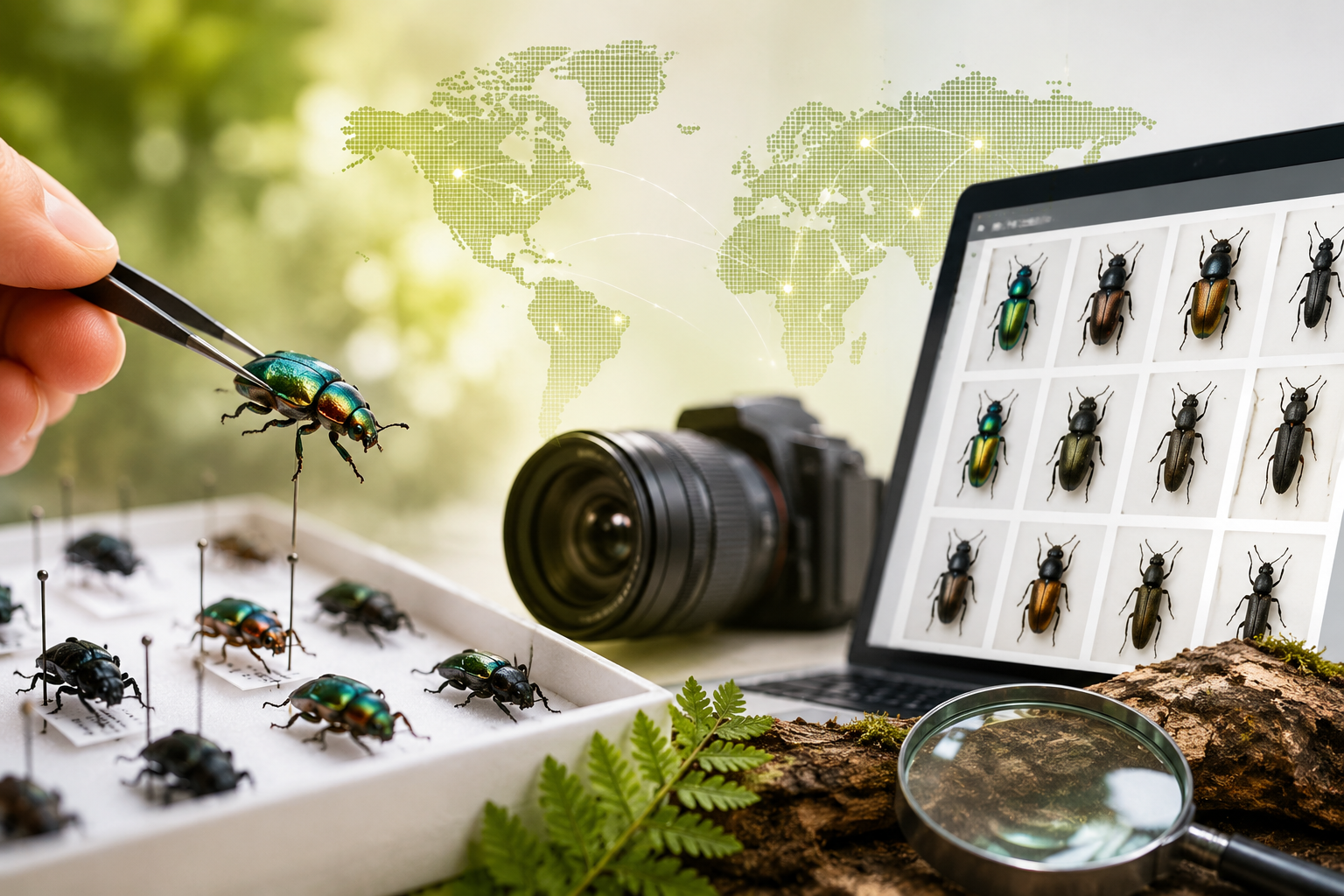
There's a particular kind of satisfaction in finding a beetle nobody else has recorded yet. Naturalists and collectors around the world can now contribute beetle specimens online, adding their finds to a growing digital insect collection archive instead of leaving them in a drawer where nobody else will ever see them.
It sounds small. It isn't. A single well-labeled specimen can end up shaping how the world understands beetle diversity long after the person who found it has moved on to something else entirely.
Consider the scale of what's still unknown. Scientists have formally described more than 380,000 beetle species, about a quarter of every known animal species combined. Entomologists suspect tens of thousands more are still out there, unnamed, tucked into forests and riverbanks nobody has properly surveyed. Every specimen added narrows that gap, even if just a little.
One of the earliest beetle catching experiences I had, was when I was about seven. I had found a tree about three metres high that had beautiful big green Buprestids feeding on the leaves.
— Colin R. Owen, founder of Beetles of Africa, on how it started for him
Why a Single Specimen Matters More Than It Seems
Label a beetle properly, its location, its date, who found it, and it carries real weight. Museum collections and digital archives run on exactly this kind of data. It's how researchers track where species live, how their ranges shift, and how habitats change around them.
A beetle picked off a specific hillside in a specific month becomes a data point someone can return to decades later. Long after the beetle, and the person who found it, are both long gone.
This isn't theoretical. Specimens collected more than a century ago still turn up in modern taxonomic papers, confirming when a species was first recorded, or occasionally revealing how its coloring or size has shifted alongside a changing climate.
It's also why so many collections now describe themselves as global resources rather than regional ones. A catalog built around African Coleoptera still gains real value from specimens sent in from Europe, the Americas, or Asia. Comparing data across regions is often what actually reveals how a species evolved and spread in the first place.
What Makes a Specimen Worth Submitting
Rarity helps, but it isn't the point. A clear photograph, an accurate location, and a real date usually matter more than how unusual the beetle is.
A dried, pinned, or otherwise well-preserved specimen holds its value more or less forever, which is exactly why entomology collections have worked as scientific records for centuries. Live insects should never go in the mail, both for the beetle's sake and to avoid introducing a species somewhere it has no business being. A short note on the habitat, forest edge, riverbank, open grassland, adds context a photo can't.
Packing a Beetle for Its Journey
None of this requires special gear. A small, rigid container beats an envelope every time, and a matchbox does the job nicely for a single beetle.
Wrap it in tissue paper, not loose cotton wool. Cotton fibers snag and snap delicate legs and antennae in transit, which is the kind of thing you only learn once, usually the hard way. Keep the specimen from shifting inside its box. Movement, more than anything else, is what breaks a beetle on its way to a new home.
From a Private Collection to a Shared Archive
There's something quietly satisfying about knowing a beetle found on one ordinary afternoon might end up cataloged next to specimens gathered decades earlier, on a completely different continent.
That's really why so many naturalists choose to contribute beetle specimens online rather than let a good find sit forgotten in a drawer. A shared archive turns scattered, individual effort into something bigger. Not because any single beetle is extraordinary on its own, but because careful, well-documented records are what let entomology keep learning.
Every Beetle Is Part of a Bigger Picture
On its own, one contributed specimen looks modest. Add up thousands of them, submitted by collectors scattered across the globe, and something closer to a long-term monitoring system starts to emerge, built not by a single institution, but by a lot of individual people paying attention.
That kind of data has only gotten more valuable as researchers try to track how species respond to habitat loss and shifting weather across decades, not single seasons.
Voices from the Field
The pull of collecting beetles isn't new, and it isn't limited to any one century or continent. A few voices worth hearing:
"...gave me so much pleasure as collecting beetles."
"...sending and receiving pinned insects is a routine activity for me."
Every collector who decides to contribute beetle specimens online joins a line of people who felt exactly the same pull, whether they were climbing a mountain in the Cape or shaking a tree as a seven-year-old boy in Rhodesia. It's one more thread in a record no single expedition could ever build alone.