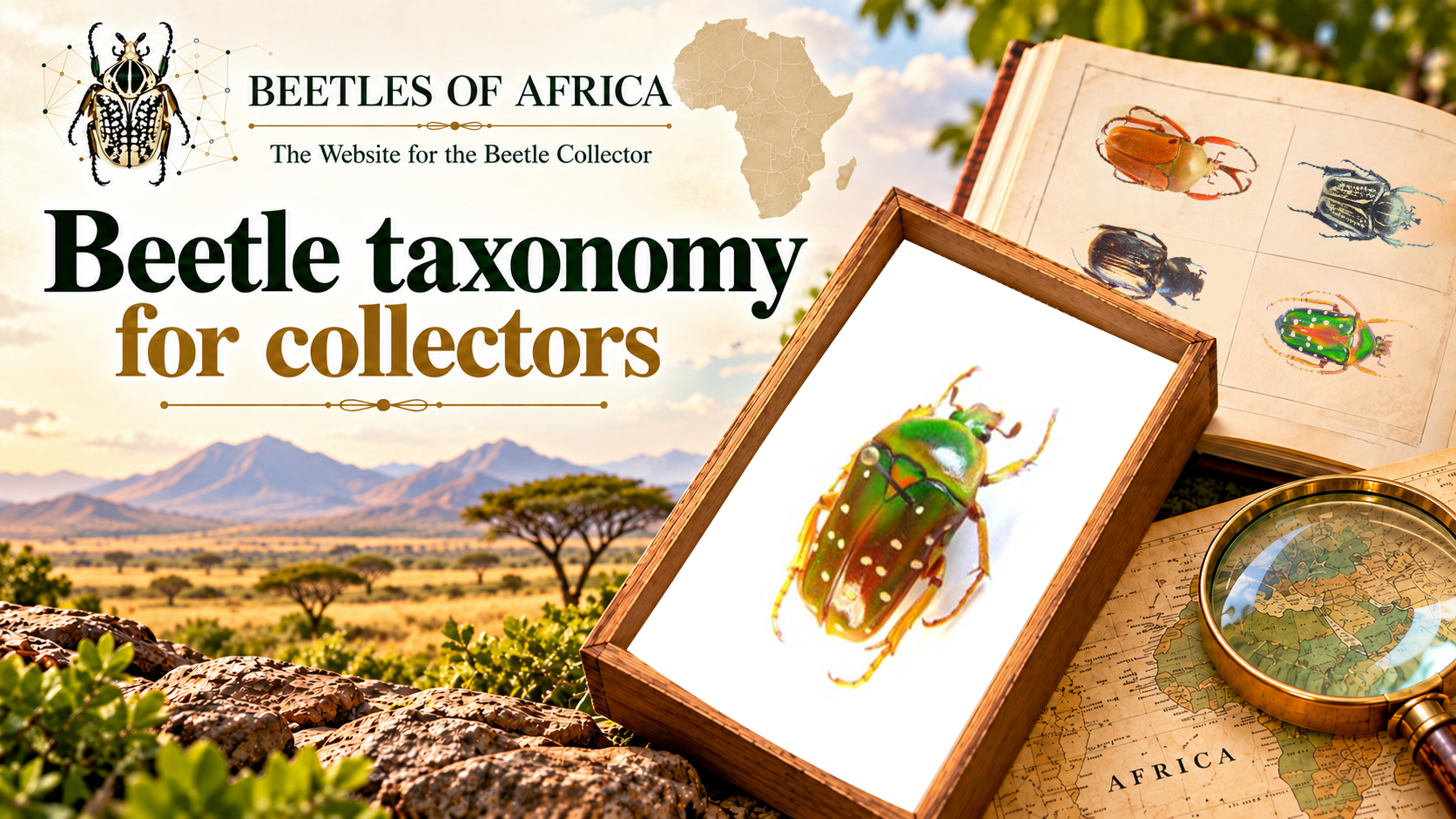
Beetle taxonomy for collectors is the system that turns a pinned, unnamed insect into a confirmed identification. It sorts every beetle into nested groups, from the order Coleoptera down to a single species. Learn the levels once, and any specimen, anywhere, has a logical place to sit.
Every beetle collector meets the same moment sooner or later: an unfamiliar specimen, a blank label, and no obvious name. Beetles of Africa, curated by Colin R. Owen, is built for exactly that moment. Its catalog groups 949 specimens into 48 families.
Why Beetles Need an Organizing System
Beetles number about 400,000 described species, roughly one in four known animal species on Earth. The order's name, Coleoptera, comes from the Greek koleopteros, a word Aristotle used for the hardened forewings that protect a beetle's back. Carl Linnaeus formalized the order in 1758.
Groups this large need structure. Without it, a collection is only a drawer of attractive insects. Even a modest regional collection spans many families, and a taxonomic frame lets each new find sit beside its relatives instead of floating alone.
"An inordinate fondness for beetles."
The Levels That Matter Most
Collectors work through a short ladder: order, family, genus, and species. Each rung narrows the group, and each one answers a smaller question. The table below shows how one famous African beetle is filed.
| Level | Name |
|---|---|
| Order | Coleoptera |
| Family | Scarabaeidae |
| Subfamily | Cetoniinae |
| Genus | Goliathus |
| Species | Goliathus regius |
Reading a Scientific Name
Every species carries two Latin words, the genus and the species, as in Goliathus regius. The genus is capitalized, the species is lowercase, and both are italicized. Author names and years often follow, showing who described the species and when.
That short label is a compact address. It tells a collector the genus at a glance and points straight to the family above it.
Four Suborders, One Big Idea
Above family sit four suborders. Adephaga holds mostly predators such as ground beetles and water beetles. Archostemata is a small group of wood eaters, and Myxophaga holds tiny, alga-feeding species.
Polyphaga dwarfs the rest, with more than 300,000 species in over 170 families. Most jewel beetles, flower beetles, weevils, and leaf beetles in a typical collection belong here.
When the Names Change
Taxonomy is a living record. Molecular work published in 2015 by McKenna and colleagues supported the idea that beetles share one common ancestor while moving several groups to new positions on the tree.
For a collector, the lesson is practical. Names printed in older field guides may now be synonyms, so confirm them against a current reference. Collections that track synonyms keep older records findable.
Working Down the Tree
Experienced collectors start broad. Body shape, antennae, and size suggest a family, and habitat or host plant narrows the field. Only then does a genus or species name enter, ideally confirmed against a labeled specimen from the same region. Skipping steps is the classic trap, since two unrelated beetles can look alike at a glance.
Colin Owen learned the broad strokes young. Growing up on mission stations in what was then Northern and Southern Rhodesia, he found a tree about three meters tall covered in jewel beetles when he was around seven. Shaking the tree dropped the beetles into his hands. He knew the family by sight long before he learned its Latin name.
Voices From the Field
"on tearing off some old bark, I saw two rare beetles, and seized one in each hand; then I saw a third and new kind, which I could not bear to lose, so that I popped the one which I held in my right hand into my mouth."
"there was nothing else to do but to go around and study nature."
Putting Taxonomy to Work in the Catalog
Beetles of Africa lets visitors browse 48 families, search by name or region, and open a world map of specimen locations. Starting at the family page and moving to genus follows the same route a trained collector takes. Featured groups such as Goliathus, Mecynorhina, Eudicella, and Stephanorrhina show how much variety one subfamily can hold. Anyone holding a Mecynorhina, for example, can move from the family page to the genus and compare photographs against nearby records on the world map.
Treat beetle taxonomy for collectors as a map, not a test. The more levels a person recognizes, the faster an unknown beetle becomes a known one. Open any family page in the catalog and the pattern repeats, with genera nested inside families and species nested inside genera.