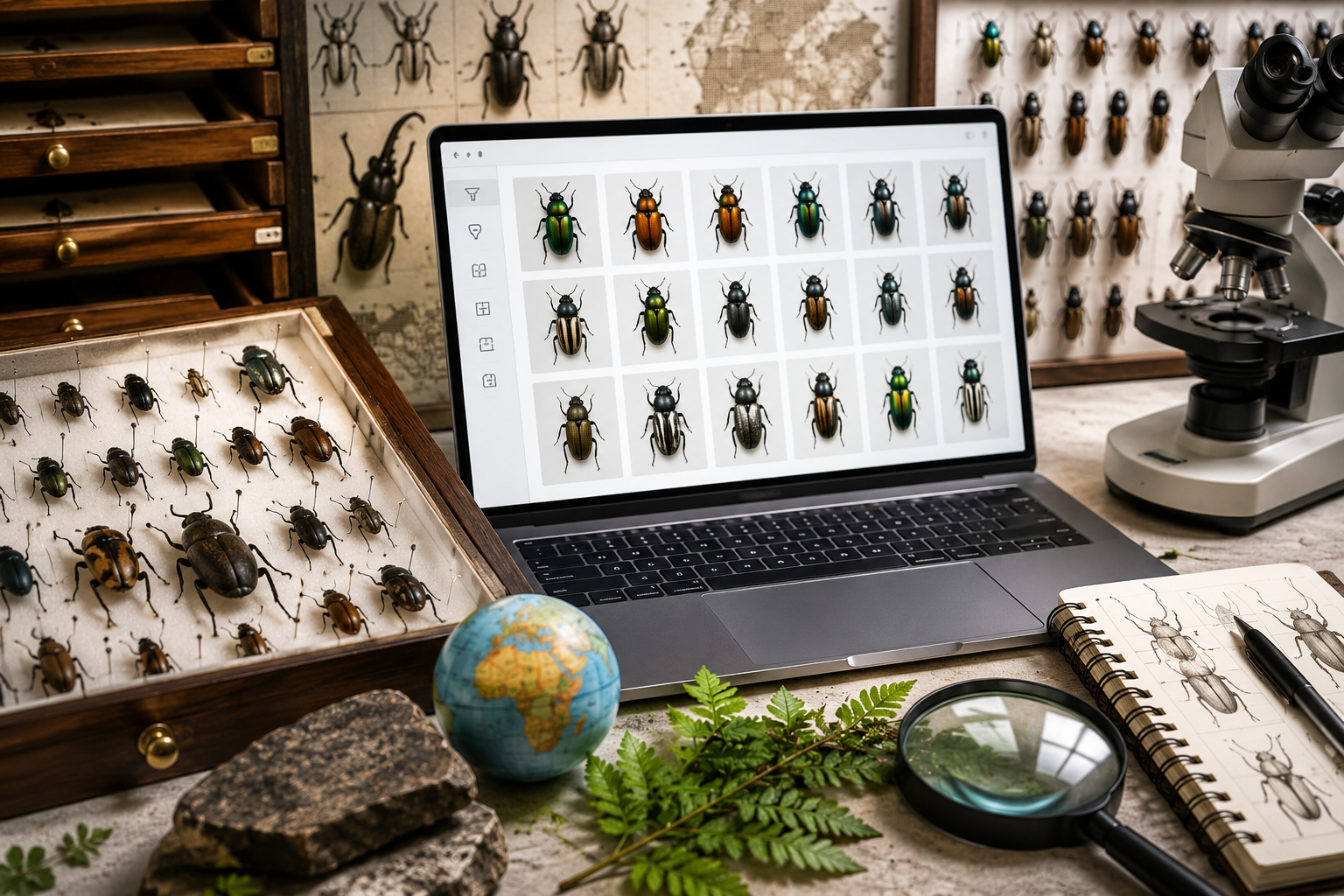
Open the drawer of any serious beetle collection and you'll find the same problem: thousands of specimens, no easy way to make sense of them without years of training. An entomology specimen catalog online solves that in a way a physical drawer never could.
It organizes by family, genus, or region, and turns decades of fieldwork into something anyone with an internet connection can actually explore, not just admire from behind glass.
Consider the scale involved. Beetles account for roughly forty percent of all described insect species, more than 400,000 species and counting. That's part of why classification matters so much here. A pile of specimens without an organized system is just a pile. Organize it, and it becomes a tool for understanding how species relate, where they live, and how they've changed.
How a Searchable Beetle Catalog Is Organized
Most digital collections start with family, the broad category separating, say, jewel beetles from stag beetles or dung beetles. From there, a visitor narrows by genus, by region, sometimes even by the specific expedition a specimen came from.
A searchable beetle catalog built this way turns a vague question into a specific answer in a few clicks. Which beetle families turn up in a particular region? Often, the answer is just a search away.
Why Classification Reveals So Much
Beetle families aren't arbitrary. They trace real evolutionary lines. Take the elytra, the hardened forewings that shield a beetle's flight wings and let it burrow, swim, or wedge itself into impossibly tight spaces without damage.
That one adaptation is a large part of why beetles have colonized nearly every terrestrial and freshwater habitat on Earth, and why they outnumber almost every other group of animals combined.
Voices from the Field
Long before digital catalogs existed, careful observers were already doing the work of naming and understanding beetles by hand. It's worth hearing from a couple of them directly:
"The Sacred beetle never chooses any shape but the sphere."
"...rarely compared their external characters with published descriptions, but got them named anyhow."
Darwin's admission is a small, human one: even a scientist of his stature was, at first, just an enthusiastic amateur trying to put names to things he loved. A searchable catalog exists to make that same process easier for everyone who comes after.
A Few Facts Worth Knowing
Some catalog entries carry genuinely surprising stories. One African dung beetle species has been shown to navigate in a straight line at night using the glow of the Milky Way, the only confirmed case of an insect steering by starlight rather than landmarks or scent.
Bombardier beetles, found across several continents, take a very different approach to survival: they mix chemicals inside their own bodies to fire a hot, irritating spray at attackers in a fraction of a second. Details like these are exactly why a searchable catalog is more than a dry reference. Casual browsing has a habit of turning into an unplanned hour of reading.
Who Actually Uses a Catalog Like This
Researchers lean on organized specimen data to study distribution and biodiversity across regions and time. Students use it to learn classification without needing access to a physical museum collection.
Hobbyist collectors often turn to a catalog to identify their own finds, checking specimens against known records before adding new ones to a personal collection. An entomology specimen catalog online quietly serves all three groups at once, no travel, lab access, or academic credentials required.
The Value of Keeping It Growing
A catalog like this is never really finished. New specimens, new locations, new photographs keep refining what's already known.
Over time, it stops feeling like a static reference and starts feeling like an ongoing record of how much, and how little, is still understood about one of the most diverse groups of animals on the planet. Even well-studied families still turn up surprises as more specimens get compared side by side, occasionally revealing a variation in color or form nobody had documented before. That's the quiet appeal of an entomology specimen catalog online: the friction of physical access disappears, but none of the detail does.